
Abstract
This research examines how celebrity endorsements influence consumer purchase intentions, focusing on physical attractiveness, source credibility, and the alignment between celebrity and brand, with brand trust as a mediating factor. Data was gathered from 200 participants through a structured questionnaire. To evaluate reliability and strength of relationship among variables, Regression Analysis and Cronbach’s Alpha were performed using SPSS software. The finding shows celebrity endorsements have significant and positive impact on consumer attitudes and purchasing behavior. Furthermore, results confirm that brand trust serves as a key mediator, strengthening the connection between celebrity endorsement and purchase intention. These insights validate the proposed hypotheses and emphasize the need for brands to strategically select endorsers who align well with their image. Future studies could expand by examining broader range of consumer groups and exploring broader influence of media and celebrity culture on consumer behavior.
Keywords
Influencer Marketing, Brand Trust, Endorser Creditability, Purchase Intension
Introduction
Literature Review
Melissa St James, emphasizes celebrity endorsements significantly enhance consumer awareness of advertisements, making them more noticeable and memorable. Several studies support the effectiveness of celebrity endorsements in marketing. Friedman explains that the celebrity is a character widely recognized due to achievements outside the product category they endorse. Compared to other types of endorsers, celebrities attract greater attention, improve recall, and foster consumer loyalty. Gan (2006) conducted a study on Chinese consumer preferences regarding advertisements featuring celebrities versus non-celebrities. The findings reveal that Chinese consumers favor celebrity endorsements, particularly when the celebrities have strong professional skills. Additional factors influencing preference include physical appearance, personality, and career achievements (Khan & Javed, 2023). Celebrities with 'The Names' that do not need further Introduction. Where on earth do they go, with renowned, and also, acknowledged with excitement? What they carry out has a media hype value. They with the objects for the means of communiqué and delight. And, a film person remains alive in people's minds even if he/she isn't an almanners' that's what properly a movie superstar (Lee, 2016). Hunter and Davidsson (2008) explored the impact of negative publicity on celebrity-backed ventures. Their study found that negative information about a celebrity can negatively affect consumer attitudes toward the associated brand or business. However, new ventures can mitigate damage by distancing themselves from the celebrity. Despite this, if the celebrity is deeply connected to the business, reputation damage may still occur. Uddin (2024) suggests that celebrity endorsers play a dominant role in advertising because they help capture attention in an otherwise cluttered media environment. Clara (2023) supports this view, noting that celebrities are often perceived as attractive, engaging, and influential, making them effective figures in promotional campaigns. Saleem (2007) Her findings emphasized that while celebrity endorsements can be highly effective, they require strategic alignment poor matches between the endorser and the product can damage brand image. Khatri (2006) describes celebrity endorsement as a strategic promotional tool designed to attract consumers and distinguish a brand in a competitive market. He notes that despite the high costs associated with hiring celebrities, marketers view this approach as an essential investment to maximize visibility and profitability. Freeman (2015) analyzed negative publicity on celebrity endorsements across cultural contexts in the U.S. and Japan. Surprisingly, their findings revealed that self-inflicted negative publicity (such as personal mistakes) could, in some cases, positively affect consumer perception of the endorsed brand. This challenges the commonly held belief that all negative publicity is damaging. Dzisah and Ocloo (2013) trace the use of celebrity endorsements back to the 19th century, noting that such promotions have long been a part of marketing strategies. Much of the academic focus has been on the credibility and attractiveness of celebrity spokespersons and how their perceived traits influence consumer responses.
Escalas and Bettman explored how celebrity endorsements influence self-brand connections. Their research indicates that consumers develop stronger brand relations with celebrities endorsing the product. However, when the celebrity's image does not align with consumer aspirations, it weakens the brand connection. The effect is more pronounced when the brand itself has a strong symbolic identity (Zhou & Patel, 2024). When consumers experience self-esteem threats, they are more likely to embrace positive celebrity-endorsed brands or reject negatively perceived endorsements. Mukherjee (2009) investigated the effectiveness of celebrity endorsements on consumer behavior and brand preference. He proposed a 20-point model that provides a blueprint for selecting celebrities strategically and maximizing their endorsement value through 360-degree brand communication. Mukherjee argues that celebrity endorsements can be highly beneficial if the right celebrity is chosen. However, if there is a difference it can create a negative perception of both the brand and the company. Celebrities with 'The Names' that do not need further Introduction. Where on earth do they go, with renowned, and also, acknowledged with excitement? What they carry out has a media hype value. They with the objects for the means of communiqué and delight. And, a film person remains alive in people's minds even if he/she isn't an almanners' that's what properly a movie superstar (Chaudhary & Asthana, 2015). Associating such individuals with brands can shift public perception and influence consumer buying behavior. Liu & Zheng (2024) add that celebrity-endorsed advertisements are more likely to stand out. Gülnil (2014) defines a celebrity endorser as someone with public recognition who promotes a product by appearing with it in media. while Homer (2007) examined the interplay between brand image and perceived quality. Her study revealed that brand image plays a greater role in shaping emotional attitudes, while quality is more influential in utilitarian product evaluations. Homer (2007) examined how consumers perceive brand meaning based on personal experiences, emotions, and social influences. Her research highlights the interplay between brand image and quality perceptions. The study found that: Brand image has a stronger influence on emotional brand attitudes, while quality dominates utilitarian brand perceptions. When a brand has a low image or quality perception, nonattribute beliefs (e.g., reputation, brand storytelling) play a stronger role in consumer decision-making. Attribute-based beliefs (e.g., product features) consistently influence consumer attitudes, regardless of image or quality levels. Mukherjee (2009) provided a comprehensive framework to evaluate celebrity endorsement strategies. His proposed 20-point model offers a blueprint for brand managers to align celebrity image with brand identity. He emphasized that while celebrity endorsements can be powerful, they must be well executed to avoid harming the brand. Similarly, Kasana and Chaudhary (2014) noted the rapid growth of the celebrity endorsement industry in India, which has become a multimillion-dollar sector. They argue that marketers increasingly use celebrities to influence consumer purchase decisions, boost sales, and expand market share.
Research Framework
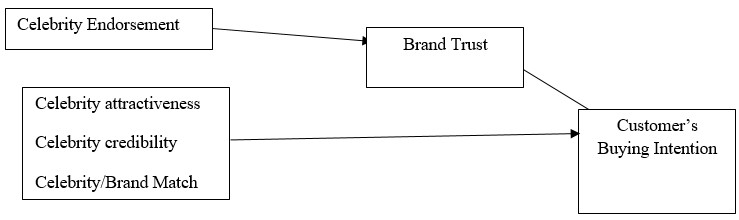
The following figure illustrates the conceptual framework, with brand trust serving as a mediating variable.
Figure 1
Hypothesis
Table 1
Male, Female
| > Frequency >Percent >Valid Percent >Cumulative Percent | > Valid width="13%">Male >100 >50 >50 >50 | > Female >100 >50 >50 >100 | > Total >200 >100 >100 >
| |
>>>
Table 2
Student, Job, Business
| > Frequency >Percent >Valid Percent >Cumulative Percent | > Valid width="16%">Student >72 >36.0 >36.0 >36.0 | > Job >65 >32.5 >32.5 >68.5 | > Business >63 >31.5 >31.5 >100.0 | > Total >200 >100.0 >100.0 >
| |
Table 3
M Phil, Masters, Bachelors
| width="16%"> Frequency width="14%">Percent width="20%">Valid Percent width="21%">Cumulative Percent | > Valid width="16%">M Phil width="16%">60 width="14%">30.0 width="20%">30.0 width="21%">30.0 | > Masters width="16%">72 width="14%">36.0 width="20%">36.0 width="21%">66.0 | > Bachelors width="16%">68 width="14%">34.0 width="20%">34.0 width="21%">100.0 | > Total width="16%">200 width="14%">100.0 width="20%">100.0 width="21%">
| |||||||||||||||||||||||||||||||||||||
| > N >Mean >Std. Deviation >Missing >No. of Extremesa | > > > > > Count >Percent >Low >High | > CR1 >200 >2.15 >.925 >0 >.0 >0 >0 | > CR2 >200 >2.29 >.899 >0 >.0 >0 >3 | > CR3 >200 >2.34 >.949 >0 >.0 >0 >1 | > CR4 >200 >2.57 >1.005 >0 >.0 >0 >3 | > CR5 >200 >2.52 >.987 >0 >.0 >0 >3 | > CR6 >200 >2.62 >1.016 >0 >.0 >0 >8 | > CR7 >200 >2.68 >1.012 >0 >.0 >0 >7 | > CC1 >200 >2.55 >.986 >0 >.0 >0 >8 | > CC2 >200 >2.69 >.979 >0 >.0 >0 >6 | > CC3 >200 >2.61 >.884 >0 >.0 >0 >2 | > CC4 >200 >2.56 >.981 >0 >.0 >0 >5 | > CC5 >200 >2.39 >1.065 >0 >.0 >0 >5 | > CBM1 >200 >2.71 >1.015 >0 >.0 >0 >9 | > CBM2 >200 >2.73 >1.002 >0 >.0 >0 >8 | > CBM3 >200 >2.66 >1.127 >0 >.0 >0 >11 | > CBM4 >200 >2.75 >1.164 >0 >.0 >0 >0 | > CBM5 >200 >2.74 >1.211 >0 >.0 >0 >0 | > PI1 >200 >2.89 >1.076 >0 >.0 >0 >0 | > PI2 >200 >2.77 >1.106 >0 >.0 >0 >0 | > PI3 >200 >2.84 >1.091 >0 >.0 >0 >0 | > PI4 >200 >2.71 >.917 >0 >.0 >0 >4 | > PI5 >200 >2.43 >.916 >0 >.0 >0 >4 | > PI6 >200 >2.45 >1.111 >0 >.0 >0 >8 | > BT1 >200 >2.77 >.889 >0 >.0 >0 >6 | > BT2 >200 >2.40 >.992 >0 >.0 >0 >5 | > BT3 >200 >2.58 >1.127 >0 >.0 >0 >16 | > BT4 >200 >2.61 >.933 >0 >.0 >0 >8 | > BT5 >200 >2.60 >1.018 >0 >.0 >0 >8 | > BT6 >200 >2.26 >.978 >0 >.0 >0 >6 | > BT7 >200 >2.48 >.902 >0 >.0 >0 >1 | > BT8 >200 >2.49 >.930 >0 >.0 >0 >1 | > BT9 >200 >2.62 >1.050 >0 >.0 >0 >6 | > a. Number of cases outside the range (Q1 - 1.5*IQR, Q3 + 1.5*IQR). | |||||||
| Kaiser Meyer Olkin Measure of Sampling Adequacy. width="17%">.791 | > Bartlett's Test of Sphericity width="40%">Approx. Chi-Square width="17%">211.276 | > Df width="17%">10 | > Sig. width="17%">.000 | |
Reliability Analysis
Beyond establishing validity, the KMO test was also applied to examine the reliability of variables included in the theoretical framework. This test assessed the consistency of the items used in the questionnaire, following the model developed during the literature review. The results, presented in the following table, demonstrate the reliability and internal consistency of the research instrument.
Table 6
Celebrity Attractiveness
| Reliability Statistics | > Cronbach's Alpha width="43%">N of Items | > .669 width="43%">7 | |
Table 7
Celebrity Credibility
| Reliability Statistics | > Cronbach's Alpha width="43%">N of Items | > .600 width="43%">5 | |
Table 8
Celebrity/Brand Match
| Reliability Statistics | > Cronbach's Alpha width="43%">N of Items | > .600 width="43%">5 | |
Table 9
Brand Trust
| Reliability Statistics | > Cronbach's Alpha width="43%">N of Items | > .600 width="43%">6 | |
Table 10
Purchase Intention
| Reliability Statistics | > Cronbach's Alpha width="43%">N of Items | > .685 width="43%">9 | |
The results indicate that all values exceed the established threshold for validity. Specifically, Cronbach’s Alpha of all variables is equal to or larger than 0.6, confirming that data is valid also internally consistent for further analysis.
Table 11
Hypothesis Testing
Coefficientsa
| Model colspan="2" width="32%">Unstandardized Coefficients width="27%">Standardized Coefficients rowspan="2" width="9%">t rowspan="2" width="12%">Sig. | > B width="17%">Std. Error width="27%">Beta | > 1 width="13%">(Constant) width="14%">1.926 width="17%">.167 width="27%">width="9%"> 11.549 width="12%">.000 | > Cravg width="14%">.308 width="17%">.066 width="27%">.313 width="9%">4.645 width="12%">.000 | |
Table 12
Coefficientsa
| Model colspan="2" width="29%">Unstandardized Coefficients width="26%">Standardized Coefficients rowspan="2" width="11%">t rowspan="2" width="11%">Sig. | > B width="17%">Std. Error width="26%">Beta | > 1 width="13%">(Constant) width="12%">1.891 width="17%">.166 width="26%">width="11%"> 11.415 width="11%">.000 | > Ccavrg width="12%">.309 width="17%">.063 width="26%">.329 width="11%">4.899 width="11%">.000 | |
Table 13
Coefficientsa
| Model colspan="2" width="33%">Unstandardized Coefficients width="18%">Standardized Coefficients rowspan="2" width="12%">t rowspan="2" width="12%">Sig. | > B width="16%">Std. Error width="18%">Beta | > 1 width="14%">(Constant) width="16%">1.863 width="16%">.148 width="18%">width="12%"> 12.544 width="12%">.000 | > CBMAVRG width="16%">.301 width="16%">.053 width="18%">.375 width="12%">5.687 width="12%">.000 | |
All of the proposed hypotheses were accepted, as their significance values were smaller than 0.05, which shows statistically significant relationships between the variables. In hypothesis testing, a p-value less than 0.05 confirms the connection between variables is significant, and the results of this study meet that criterion. Additionally, the Beta coefficient represents the standardized regression coefficient, which allows for direct comparison among variables by placing them on the same scale. This standardization provides clearer insight into the relative strength and direction of each predictor’s effect within the model.
Table 14
Corelation
| width="12%"> cravg width="12%">ccavrg width="14%">CBMAVRG width="12%">Planrg width="12%">BTAVRG | > cravg width="23%">Pearson Correlation width="12%">1 width="12%">.466** width="14%">.414** width="12%">.313** width="12%">.480** | > Sig. (2-tailed) width="12%">width="12%"> .000 width="14%">.000 width="12%">.000 width="12%">.000 | > N width="12%">200 width="12%">200 width="14%">200 width="12%">200 width="12%">200 | > ccavrg width="23%">Pearson Correlation width="12%">.466** width="12%">1 width="14%">.312** width="12%">.329** width="12%">.450** | > Sig. (2-tailed) width="12%">.000 width="12%">width="14%"> .000 width="12%">.000 width="12%">.000 | > N width="12%">200 width="12%">200 width="14%">200 width="12%">200 width="12%">200 | > CBMAVRG width="23%">Pearson Correlation width="12%">.414** width="12%">.312** width="14%">1 width="12%">.375** width="12%">.317** | > Sig. (2-tailed) width="12%">.000 width="12%">.000 width="14%">width="12%"> .000 width="12%">.000 | > N width="12%">200 width="12%">200 width="14%">200 width="12%">200 width="12%">200 | > planrg width="23%">Pearson Correlation width="12%">.313** width="12%">.329** width="14%">.375** width="12%">1 width="12%">.364** | > Sig. (2-tailed) width="12%">.000 width="12%">.000 width="14%">.000 width="12%">width="12%"> .000 | > N width="12%">200 width="12%">200 width="14%">200 width="12%">200 width="12%">200 | > BTAVRG width="23%">Pearson Correlation width="12%">.480** width="12%">.450** width="14%">.317** width="12%">.364** width="12%">1 | > Sig. (2-tailed) width="12%">.000 width="12%">.000 width="14%">.000 width="12%">.000 width="12%">
| > N width="12%">200 width="12%">200 width="14%">200 width="12%">200 width="12%">200 | |
Multicollinearity analysis is used to determine whether any predictor variables are strongly correlated with one another. A Pearson correlation coefficient of 0.7 or higher, along with a significance level (p-value) of 0.05 or lower, typically indicates the presence of multicollinearity and a statistically significant relationship. According to the referenced table, the majority of variables in this study show significant positive correlations. This shows that as the value of one variable increases, the values of the other variables tend to increase as well, indicating a direct and positive relationship among them.
Mediation Analysis
Table 15
Mediation analysis by taking celebrity attractiveness as independent variable
Model Summary
| R width="97">R-sq width="97">MSE width="97">F width="97">df1 width="97">df2 width="97">p | > .3969 width="97">.1575 width="97">.2595 width="97">18.4171 width="97">2.0000 width="97">197.0000 width="97">.0000 |
Table 16
Coefficients Table
| width="97"> Coeff width="97">se width="97">t width="97">p width="97">LLCI width="97">ULCI | > constant width="97">1.5061 width="97">.1972 width="97">7.6394 width="97">.0000 width="97">1.1173 width="97">1.8949 | > BTAVRG width="97">.2925 width="97">.0786 width="97">3.7224 width="97">.0003 width="97">.1375 width="97">.4474 | > Cravg width="97">.1772 width="97">.0732 width="97">2.4187 width="97">.0165 width="97">.0327 width="97">.3216 |
Table 17
Mediation analysis by taking celebrity credibility as independent variable Model Summary
| R width="14%">R-sq width="14%">MSE width="14%">F width="14%">df1 width="14%">df2 width="14%">p | > .4082 width="14%">.1666 width="14%">.2567 width="14%">19.6905 width="14%">2.0000 width="14%">197.0000 width="14%">.0000 |
Table 18
Coefficients Table
| width="97"> coeff width="97">se width="97">t width="97">p width="97">LLCI width="97">ULCI | > constant width="97">1.4607 width="97">.1978 width="97">7.3833 width="97">.0000 width="97">1.0705 width="97">1.8508 | > BTAVRG width="97">.2855 width="97">.0768 width="97">3.7184 width="97">.0003 width="97">.1341 width="97">.4370 | > Ccavrg width="97">.1944 width="97">.0685 width="97">2.8389 width="97">.0050 width="97">.0594 width="97">.3295 |
Table 19
Mediation analysis by taking celebrity/brand match as independent variable Model Summary
| R width="97">R-sq width="97">MSE width="97">F width="97">df1 width="97">df2 width="97">p | > .4552 width="97">.2072 width="97">.2442 width="97">25.7499 width="97">2.0000 width="97">197.0000 width="97">.0000 |
Table 20
Coefficients Table
| width="97"> coeff width="97">se width="97">t width="97">p width="97">LLCI width="97">ULCI | > constant width="97">1.3237 width="97">.1948 width="97">6.7956 width="97">.0000 width="97">.9395 width="97">1.7078 | > BTAVRG width="97">.2873 width="97">.0705 width="97">4.0747 width="97">.0001 width="97">.1483 width="97">.4264 | > CBMAVRG width="97">.2318 width="97">.0538 width="97">4.3096 width="97">.0000 width="97">.1257 width="97">.3379 |
The results indicate that brand trust acts as a significant mediating variable in all three scenarios analyzed. This finding tells that brand trust plays important role in the relationship between celebrity endorsement including celebrity attractiveness, credibility, and celebrity brand congruence and the customers purchase opinion. In other words, the influence of celebrity endorsement on customer purchase behavior is enhanced when brand trust is present, highlighting the importance of building and maintaining brand credibility in endorsement strategies.
Conclusion
The practice of celebrity endorsements has grown
significantly in recent years, becoming a persuasive force in modern advertising. Advertising remains one of the most effective ways to influence consumer behavior, and its evolution from traditional to modern forms highlights the growing role of celebrities in promotional strategies. The inclusion of celebrities in advertisements has shown to significantly impact consumer decision making, particularly in stimulating purchase intentions. Marketers increasingly adopt celebrity driven advertising to boost product sales and enhance market share. These endorsements inject energy into competitive markets, making it crucial for businesses to strategically select celebrities that align with their brand image. The empirical findings of this study affirm that celebrity advertising contributes meaningfully to increased sales and brand growth. Furthermore, the results were obtained through reliable and well established methodologies, reinforcing the validity of the study. Another critical finding is the role of brand trust. Celebrities are often perceived as role models or icons, and when consumers view them as credible, attractive, and well matched with a product, they are more likely to develop favorable attitudes toward the brand sometimes even placing less emphasis on the product's actual features.
The results show that trust in a brand plays a significant role in consumer purchase intentions. When consumers trust a brand, the influence of celebrity endorsements becomes even more effective. This explains why well established and reputable brands often benefit more from celebrity endorsements they already enjoy a foundation of consumer trust, which amplifies the impact of celebrity influence. Overall, this study finds that celebrity endorsements are not merely influential but also serve as a direct factor in shaping consumers' purchasing decisions. Each of the key elements significantly contributes to forming consumer perceptions toward the endorsed brand. Additionally, brand trust acts as a strong mediating factor, enhancing the effectiveness of celebrity endorsements in boosting sales and strengthening market presence. However, this study is not without limitations. Although 200 respondents is a reasonable sample size, a more diversified demographic such as, non-working individuals, and retirees may have yielded broader or different insights. Despite these limitations, it also opens avenues for future research. Since the findings point to a strong connection between celebrity endorsements and consumer behavior, future studies may explore the broader impact of media on different consumer segments or examine the comparative effectiveness of different types of celebrity endorsements across industries and platforms.
References
Cite this article
-
APA : Khan, N., & Khan, Z. U. (2025). The Influence of Celebrity Endorsements on Customers' Purchase Intentions: The Mediating Role of Brand Trust. Global Sociological Review, X(II), 34-47. https://doi.org/10.31703/gsr.2025(X-II).04
-
CHICAGO : Khan, Naveed, and Zargham Ullah Khan. 2025. "The Influence of Celebrity Endorsements on Customers' Purchase Intentions: The Mediating Role of Brand Trust." Global Sociological Review, X (II): 34-47 doi: 10.31703/gsr.2025(X-II).04
-
HARVARD : KHAN, N. & KHAN, Z. U. 2025. The Influence of Celebrity Endorsements on Customers' Purchase Intentions: The Mediating Role of Brand Trust. Global Sociological Review, X, 34-47.
-
MHRA : Khan, Naveed, and Zargham Ullah Khan. 2025. "The Influence of Celebrity Endorsements on Customers' Purchase Intentions: The Mediating Role of Brand Trust." Global Sociological Review, X: 34-47
-
MLA : Khan, Naveed, and Zargham Ullah Khan. "The Influence of Celebrity Endorsements on Customers' Purchase Intentions: The Mediating Role of Brand Trust." Global Sociological Review, X.II (2025): 34-47 Print.
-
OXFORD : Khan, Naveed and Khan, Zargham Ullah (2025), "The Influence of Celebrity Endorsements on Customers' Purchase Intentions: The Mediating Role of Brand Trust", Global Sociological Review, X (II), 34-47
-
TURABIAN : Khan, Naveed, and Zargham Ullah Khan. "The Influence of Celebrity Endorsements on Customers' Purchase Intentions: The Mediating Role of Brand Trust." Global Sociological Review X, no. II (2025): 34-47. https://doi.org/10.31703/gsr.2025(X-II).04