
Abstract
The main objectives of the study were to the effect of Physiological and consideration for Elite Young Females Athletes to participate in physical Activities. The researcher used a Likert-type questionnaire as a tool for data collection. The questionnaire was consisting of two different portions the first portion was developed to investigate. The main purpose of the study was to the influence of sociocultural problems on sports participation among college female athletes. Based on data analysis following findings float ups. The collected data from questionnaires were put into the SPSS (Version-20) for the purpose of data analysis. The data analysis was performed in three different sections demographic information was given in Section A, Section B deals with the item-wise frequencies and percentages of the questionnaire and Section C deals with the testing of hypotheses. The alpha level for testing hypotheses was .05.
Key Words
Introduction
According to Rauzon (2002), the physiological factors that are causing a problem in the way of participation of females in athletics and other sports activities included small lungs as compared to males which causes breathing problems which result in lower stamina. The weak muscles and skeleton of females also act as an obstacle for female athletes to compete because the risk of major injuries is increased at a high rate. The potential of athlete’s male is more than that of female athletes so they cannot compete in this way. The muscles and skeleton of females in noticed in many activities and it fails to respond completely in energetic activities. This acts as one of the major barriers in the way of female participation in sports activities.
Orunaboka and Kemebradikumo (2007) noticed that the joints of females are smaller in size as compared to the males and also the capacity of muscle efficiency is very much low in females as compared to the males. The number of red blood cells, blood volume, circulatory system, Small heart size and high heart rate, reduced lungs and less efficient muscles and joints of females as compared with that of male participants act as a hamper for the female athletes to participate in sports activities. In all manners, the female's body is less efficient to perform required work so it also acts as a barrier for them to participate.
Currently, Pakistan is facing a high birth rate problem and the rate at which our population is increasing is quite a dangerous one. At the present occasion, Pakistan is given the sixth number among the countries with a high populating rate. Along with 51.35% males the percentage of females is also very high at the current occasion with a percentage of 48.65%.
But due to cultural restrictions, only men are given importance in choosing their lifestyle and activities while females are ignored in all manners to a very dangerous level. Half of the population of Pakistan is comprised of females but they are ignored in all parts of life. Irrespective of having such a high population level only very few females are introduced at national and international levels to represent Pakistan in athletics and sports activities, which is a real dishonour being a nation.
Regular exercise has been shown to aid in the management and prevention of non-communicable conditions such as diabetes, coronary artery disease, stroke, and a variety of cancers. Furthermore, it improves overall quality of life, maintains a healthy body size, decreases cholesterol levels, and improves both physical and psychological wellness.
The following major elements, according to Martin (2010), were revealed by reviewing the research on "physical activity, fitness, and academic success" The overwhelming mostly of school-based, widely disseminated research in this area has discovered a beneficial relationship between kids' engagement in physical exercise and academic success. Caspersen's definition was somewhat modified in 2017 for the World Health Organization's (WHO) Global Strategy on Increasing Physical Activity. The WHO refers to a bodily movement that "requires energy spending" as opposed to an activity that uses up energy.
Your legs and arms, as well as other big muscles, are moved during aerobic exercise. Aerobic exercise includes things like running, swimming, walking, biking, dancing, and performing jumping jacks. The term "endurance activity" also applies to aerobic exercise.
Your heart beats more quickly during aerobic exercise. Furthermore, this kind of exercise makes you breathe more heavily. Regular aerobic exercise strengthens and improves the function of both your lungs and your heart over time.
The Objective of the Study
The research in hand is primarily related to the sociocultural problems in the way of female sports participation. Therefore, the sub-objectives which the researcher made an effort to achieve were:
1. To analyse the influence of societal constraints on College level female sports participation.
2. To assess the influence of cultural limitations on college-level female sports participation.
3. To determine the effect of different demographic factors on the respondents regarding the effect of societal constraints upon female college sports.
The Hypothesis of the Study
The following research hypotheses were formulated in line with the set objectives of the study.
1. H0: insignificant among the viewpoint of respondents from different localities regarding the effect of physiological limitations on physical activity participation of female athletes at the college level.
2. H0: insignificant among the viewpoint of local and non-local respondents regarding the effect of physiological limitations on physical activity participation of female athletes at the college level.
3. H0: insignificant among the viewpoints of respondents who take part in sports competitions at different levels regarding the influence of Cultural limitations on sports participation of female athletes at the college level.
Research Methodology
Research Philosophy
It is the concepts of the researcher about the knowledge that what is the real concept of knowledge. And how it could be gathered and documented? And how it could be communicated? It is the belief of Positivism that indicates that knowledge can be verifiable objectively. Observational symbols also be helpful in recording and communicating knowledge like words and concepts. According to these beliefs about research philosophy, the researcher has used scientific methodology based on surveys of literature and field surveys.
Survey Approach
A survey approach was used and a questionnaire was utilized to gather information from the respondents. For to recorded human behaviour, opinion and perceptions Survey research approach are very popular, handy and commonly used in social sciences.
Population & Sample
Population
All the students of female colleges of Sialkot, Punjab, Pakistan were the matter of interest of the researcher to collect information.
Sample
Gay (1987) has done a lot of work in research methodology as well as with special reference to sampling, Gay, defines the sample as. It is the small group of individuals which supposed to represent a larger population. In general, when the population is large and due to some factors such as time allocation, knowledge, equipment and facilities the researcher can't investigate and collect data from all the members of the population the researcher then takes a small portion from the large population to generalize the results. But there should be some hard and soft rules, and the characteristics of the sample and population should be the same. L. R. Gay (1987) also produce the formula for taking the sample from the population.
Data Collection Instrument
Researchers around the world used different types of instruments to collect data. Which depends upon the nature of the study, the nature of the hypotheses testing and some other general factors. A questionnaire is a tool which is easy to make, prepare, validate and make reliable.
There are a lot of benefits of a questionnaire (tool as a data collection) reported in the literature. In this particular study, the researcher used a Likert-type scale. This five-option scale with equal interval ratio and interval scale.
The researcher collected the data by self and represent it to the respondents and elaborate that, this study was only for research purposes this information was not shared or presented for other purposes. The researcher gives some time to the respondents to think about the statements and options of the questionnaire and respond to is best desirable options.
Reliability and validity of the instrument and procedure
The researcher used a Likert-type questionnaire as a tool for data collection. The options of the questionnaire were five from strongly disagreed to strongly agreed ranging from 1 to five respectively. The questionnaire was consisting of two different portions.
The initial stage of the scale consisted of a total of 60 items 30 items in each portion of the questionnaire. The initial draft of the questionnaire was sent to the expert in the field for the purpose of validity (face and content validity) and reliability (Cronbach's alpha reliability method appeared as .854) of the questionnaire. some of the items were deleted on the basis of expert views and pilot testing the final version of the questionnaire was consisting of 40 items 20 valid and reliable items in each portion of the questionnaire.
Data Analysis (Testing of Hypotheses)
The researcher used appropriate and authentic tools to test the hypothesis, the researcher assume that Correlations, T, test and ANOVA were the best to test the hypotheses and Mode and frequency were the best tools to represent the Likert-type data.
Table 1
List of Demographic Variables and Operational Definitions and Code
| # width="26%">Variable width="57%">Operational Definition width="11%">Code | > 1. width="26%">Age width="57%">15 years, 16 Years,17 Years and above width="11%">AG | > 2. width="26%">Locality width="57%">rural and urban width="11%">LC | > 3. width="26%">Domicile; width="57%">local and non-local width="11%">DM | > 4. width="26%">Participating in different games width="57%">Cricket, Football, Net Ball, Badminton, Table Tennis and Others width="11%">PDG | > 5. width="26%">Different cast; width="57%">Gujjar, Rajput, jatt width="11%">DC | > 6. width="26%">Sports competition width="57%">Intercollegiate, Interuniversity and District level/divisional level width="11%">SC | > 7. width="26%">Social Class width="57%">respondents from different social classes width="11%">SCL |
Results & Discussion:
Section A: Demographic information of the respondents
Figure 1
Bar Graph Showing age Group-wise Frequencies of Respondents
 Figure 1 shows the frequencies and percentages of the sample. The total number of respondents having the age 15 years was 225 the percentage of the 15 years old respondents was 29.2%). The total 16 years of age respondents were 363 (47.1%) and 17 years and above were 183 (23.7%). The total number of respondents from 15 years to 17 years and above were 771 (100%).
Figure 2
Bar Graph Showing the Locality of the Respondents-wise Frequencies
 Figure 2 shows the frequencies and percentages of the respondents having different localities. The number of rural respondents was 400 (51.9%) and urban respondents were 371 (48.1%). The total number of respondents from different localities was 771 (100%).
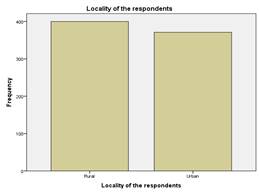
Figure 3
Bar Graph Showing Domicile-wise Frequencies and Percentages of the Respondents
 Figure 3 shows the frequencies and percentages of the respondents domicile-wise. The total number of local respondents in the sample was 596 (77.3%) and the total non-local respondents were 175 (22.7%). The total local and non-local respondents of the study were 771 (100%).
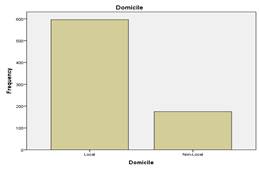
Figure 4
Bar Graph Showing the Frequencies of Respondents' Sports Activity-wise
 Figure 4 shows the frequencies and percentages of the respondents on the basis of participation in different sports activities. The total respondents participating in Cricket were 99 (12.8%), Football 115 (14.9%), Net Ball 260 (33.7%), Badminton 233 (30.2%), Table Tennis 16 (2.1%) and 48 (6.2%). The total number of respondents participating in different games was 771 (100%).
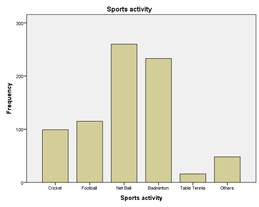
Figure 5
Bar Graph Showing the Frequencies of Respondent’s Competition Level-wise
 Figure 5 shows the frequencies and percentages of the sample competition level-wise. There were a total of three different levels of competition. Intercollegiate level, interuniversity level and district level/divisional level. The total number of respondents competing at the intercollegiate level was 745 (96.6%), interuniversity was 18 (2.3%) and Divisional level was 8 (1%). The total number of respondents competing at different levels of sports was 771 (100%).
Section B: Item-Wise Frequencies and Percentages of the Respondents
> >Table 2>Physiological Constraints for Girls to Participate in Sports Activities at the College Level border="0" cellspacing="0" cellpadding="0" width="100%">#
width="44%">Statement
width="10%">SAF(%)
width="10%">AF(%)
width="11%">UDF(%)
width="10%">DAF(%)
width="9%">SDAF(%)
1.
width="44%">Relations taunt while girls play
width="10%">489 align="center">(63%)
width="10%">113 align="center">(15%)
width="11%">69 align="center">(9%)
width="10%">56 align="center">(7%)
width="9%">44 align="center">(6%)
2.
width="44%">Relatives and acquaintances discourage the Parents from their girl's participation in sports activities.
width="10%">421 align="center">(55%)
width="10%">134 align="center">(17%)
width="11%">87 align="center">(11%)
width="10%">104 align="center">(13%)
width="9%">25 align="center">(3%)
3.
width="44%">Maintaining the balance among families given responsibilities and girls' sports participation is a big problem for girls in college sports.
width="10%">451 align="center">(58%)
width="10%">112 align="center">(15%)
width="11%">89 align="center">(12%)
width="10%">66 align="center">(9%)
width="9%">53 align="center">(7%)
4.
width="44%">Fear of emotional threats is also a problem for a girl to participate in sports activities
width="10%">444 align="center">(58%)
width="10%">125 align="center">(16%)
width="11%">88 align="center">(11%)
width="10%">59 align="center">(8%)
width="9%">55 align="center">(7%)
5.
width="44%">Unnecessary watchfulness/vigilance of society upon girls hinders the sports participation of girls at the college level.
width="10%">367 align="center">(48%)
width="10%">177 align="center">(23%)
width="11%">48 align="center">(6%)
width="10%">67 align="center">(9%)
width="9%">112 align="center">(15%)
6.
width="44%">Fear of domestic abuse is one of the problems which restricts girls' participation in sports
width="10%">543 align="center">(70%)
width="10%">112 align="center">(15%)
width="11%">45 align="center">(6%)
width="10%">54 align="center">(7%)
width="9%">17 align="center">(2%)
7.
width="44%">Due to gender-based violence, girls deny sports participation
width="10%">462 align="center">(60%)
width="10%">143 align="center">(19%)
width="11%">57 align="center">(7%)
width="10%">46 align="center">(6%)
width="9%">63 align="center">(8%)
8.
width="44%">Parents are happy to see their boys in playgrounds, not girls
width="10%">234 align="center">(30%)
width="10%">265 align="center">(34%)
width="11%">58 align="center">(8%)
width="10%">114 align="center">(15%)
width="9%">100 align="center">(13%)
9.
width="44%">There is unequal access to playgrounds for girls
width="10%">359 align="center">(47%)
width="10%">188 align="center">(24%)
width="11%">87 align="center">(11%)
width="10%">103 align="center">(13%)
width="9%">34 align="center">(4%)
10.
width="44%">Stalking is one of the social problems which restrict girls to participate in sports activities
width="10%">345 align="center">(45%)
width="10%">168 align="center">(22%)
width="11%">69 align="center">(9%)
width="10%">118 align="center">(15%)
width="9%">71 align="center">(9%)
>Table 3>Traditional Limitations for Girls to Participate in Physical Activities at the College Level border="0" cellspacing="0" cellpadding="0">
#
width="270">Statement
width="55">SAF(%)
width="47">AF(%)
width="47">UDF(%)
width="46">DAF(%)
width="47">SDAF(%)
1.
width="270">The male-dominant culture is a limitation for girls to participate in sports activities.
width="55">425 align="center">(55%)
width="47">219 align="center">(28%)
width="47">39 align="center">(5%)
width="46">21 align="center">(3%)
width="47">67 align="center">(9%)
2.
width="270">Watchfulness of different cultures is one of the limitations for girls which restricts their participation in sports activities.
width="55">458 align="center">(59%)
width="47">187 align="center">(24%)
width="47">58 align="center">(8%)
width="46">26 align="center">(3%)
width="47">42 align="center">(5%)
3.
width="270">Early girl marriage culture restricts the girls in sports activities
width="55">501 align="center">(65%)
width="47">122 align="center">(16%)
width="47">115 align="center">(15%)
width="46">8 align="center">(1%)
width="47">25 align="center">(3%)
4.
width="270">The cultural dress code of our culture is one of the limitations for girls to participate in sports activities.
width="55">413 align="center">(54%)
width="47">143 align="center">(19%)
width="47">123 align="center">(16%)
width="46">41 align="center">(5%)
width="47">51 align="center">(7%)
5.
width="270">Fear of being punished due to violation of cultural rules and regulation restrict the girls to participate in sports activities
width="55">426 align="center">(55%)
width="47">219 align="center">(28%)
width="47">113 align="center">(15%)
width="46">8 align="center">(1%)
width="47">5 align="center">(1%)
6.
width="270">someone's custody of girls in our culture limited the girls to reach playgrounds
width="55">225 align="center">(29%)
width="47">287 align="center">(37%)
width="47">125 align="center">(16%)
width="46">63 align="center">(8%)
width="47">71 align="center">(9%)
7.
width="270">Being neither a princess nor a queen decreases the self-esteem of the girls which leads towards low participation
width="55">422 align="center">(55%)
width="47">122 align="center">(16%)
width="47">92 align="center">(12%)
width="46">31 align="center">(4%)
width="47">104 align="center">(13%)
8.
width="270">Our beliefs don’t allow us to participate in sports in that existing way
width="55">558 align="center">(72%)
width="47">136 align="center">(18%)
width="47">70 align="center">(9%)
width="46">6 align="center">(1%)
width="47">1 align="center">(0%)
9.
width="270">Girls can't participate in sports activities without having a fully covered place
width="55">448 align="center">(58%)
width="47">119 align="center">(15%)
width="47">70 align="center">(9%)
width="46">29 align="center">(4%)
width="47">105 align="center">(14%)
10.
width="270">The negative behaviour of brothers of girls limited the girls' participation in sports activities
width="55">468 align="center">(61%)
width="47">164 align="center">(21%)
width="47">78 align="center">(10%)
width="46">22 align="center">(3%)
width="47">39 align="center">(5%)
>Testing Hypotheses
>Table 4.1>Regression showing the impact of physiological constraints on Physical activity participation of female athletes at the college level. >Model Summary border="0" cellspacing="0" cellpadding="0" width="100%">Model
width="14%">R
width="14%">R Square
width="20%">Adjusted R Square
width="20%">F
width="20%">Sig.
1
width="14%">.781a
width="14%">.636
width="20%">.635
width="20%">2821.123
width="20%">.001b
a. Predictors: (Constant), Societal Constraints
width="20%" valign="top">
b. Dependent Variable: Sports participation of female athletes
width="20%" valign="top">
Model
width="30%" colspan="2">Unstandardized Coefficients
width="26%">Standardized Coefficients
width="8%" rowspan="2">T
width="5%" rowspan="2">Sig.
B
width="15%">Std. Error
width="26%">Beta
1
width="19%">(Constant)
width="15%">.877
width="15%">.057
width="26%">width="8%">
21.042
width="5%">.000
Societal Constraints
width="15%">.718
width="15%">.042
width="26%">.781
width="8%">36.114
width="5%">.001
a. Dependent Variable: Sports participation of female athletes
There above Tables 4 and 4 show that societal constraints are significantly influencing the sports participation of female athletes at the college level. The results show that the relationship between societal constraints and sports participation of female athletes was 63% which appeared as positive and strong. The results show that r = .781, R Square = .636, adjusted r square = .635 F= 2821.123 and Sig. = .001. The results also show that if a one-unit increase in the independent variable .718 units increase independent variables. When Table 4 and 4 were analyzed cumulatively the results shows that societal constraints significantly predicted sports participation of female athletes at the college level ?= .718, t= 21.042, Sig,= .001 < ?= .05. Societal constraints also explain a significant proportion of variance in girl's participation in sports activities at college level R2= .636, F= 2821.123, Sig.= .001 < ?= .05. Hence the hypothesis societal constraints are significantly influencing sports participation of female athlete at college level is hereby accepted.
Table 5
ANOVA shows the difference among the viewpoint of respondents having different age groups.
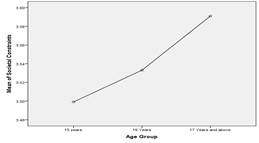
| Age Groups width="8%">N width="10%">Mean width="14%">Std. Deviation width="14%">Df width="14%">F width="14%">Sig. | > 15 years width="8%">225 width="10%">3.4991 width="14%">1.01889 width="14%" rowspan="4">2, 768 width="14%" rowspan="4">.431 width="14%" rowspan="4">.650 | > 16 Years width="8%">363 width="10%">3.5331 width="14%">.99454 | > 17 Years and above width="8%">183 width="10%">3.5910 width="14%">.98702 | > Total width="8%">771 width="10%">3.5369 width="14%">.99920 |
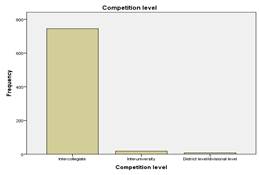
Figure 5
Mean Plot showing the mean of respondents age wise

The above Table 5 shows the difference among the viewpoint of respondents having different age groups regarding the influence of societal constraints on girls' sports participation. The results of ANOVA appeared as F(2, 768)= .431, Sig.= .650 > ?= .05 which indicates that insignificant among age-wise groups regarding the effect of societal constraints upon female college sports. Hence the null hypothesis insignificant among viewpoints of respondents having different age groups regarding the influence of societal constraints on sports participation of female athletes at the college level is hereby accepted.
> >Table 6>T-test Showing the Difference Among the Viewpoint of Respondents from Different Localities. border="0" cellspacing="0" cellpadding="0" width="100%">
Testing Variables
width="22%">Locality
width="6%">N
width="11%">Mean
width="14%">Std. Deviation
width="8%">Df
width="7%">T
width="6%">Sig.
Societal Constraints
width="22%">Rural
width="6%">400
width="11%">3.5584
width="14%">.98195
width="8%" rowspan="2">769
width="7%" rowspan="2">.619
width="6%" rowspan="2">.536
Urban
width="6%">371
width="11%">3.5137
width="14%">1.01829
The above Table 6 shows the difference among the viewpoint of respondents from different localities regarding the influence of societal constraints on girls' sports participation at the college level. The results of the t-test appeared as t(769)= .619, Sig.= .536 > ?= .05. Which indicates that the viewpoint of respondents from different localities was the same regarding the influence of societal constraints upon girl's participation in sports activities. Hence the null hypothesis insignificant among the viewpoint of respondents from different localities regarding the influence of societal constraints on sports participation of female athletes at the college level is hereby accepted.
> >Table 7>T-test Showing the Difference Among the Viewpoint of Local and Non-local Respondents. border="0" cellspacing="0" cellpadding="0" width="99%">
Testing Variables
width="13%">Domicile
width="6%">N
width="9%">Mean
width="12%">Std. Deviation
width="13%">df
width="13%">T
width="13%">Sig.
Societal Constraints
width="13%">Local
width="6%">596
width="9%">3.5639
width="12%">.98919
width="13%" rowspan="2">769
width="13%" rowspan="2">1.387
width="13%" rowspan="2">.119
Non-Local
width="6%">175
width="9%">3.4449
width="12%">1.03014
The above Table 7 shows the difference among the viewpoint of local and non-local respondents regarding the influence of societal constraints on girls' sports participation at the college level. The results of the t-test appeared as t(769)= 1.387, Sig.= .119 > ?= .05. Which indicates that the viewpoint of local and non-local respondents was the same regarding the influence of societal constraints upon girls' participation in sports activities. Hence the null hypothesis insignificant among the viewpoint of local and non-local respondents regarding the influence of societal constraints on sports participation of female athletes at the college level is hereby accepted.
Discussion
The researcher also observed that maintaining the balance among families given responsibilities and girls' sports participation is a big problem for girls in college sports. Fear of harassment is a problem for girls who go outside the home to participate in sports. The Fear of being robbed is a problem for girls which creates hurdles to participating in sports activities and the Fear to be hostage hinders the move towards girls to the ground.
The researcher also observed the philosophy behind the results that democracy restricts the girl’s participation in sports activities and relations taunt while girls play Fear of emotional threats is also a problem for girls to participate in sports activities. Unnecessary watchfulness/vigilance of society upon girls hinders the sports participation of girls at the college level.
In respect of college attitude and behaviour, the researcher observed that there is unequal access to playgrounds for girls which leads to towards negative effect on girls' participation in sports activities. Fear of domestic abuse is one of the problems which restricts girl's participation in sports, Due to gender-based violence girls deny sports participation and Parents are happy to see their boys in playgrounds, not girls the results indicate that stalking is one of the social problems which restricts girls to participate in sports activities.
The results of the present study are linked and in line with previous studies which have been done recently in different corners of the world.
The results show that there is a significant influence of cultural limitations on girls' participation at the college level. Since our beliefs don't allow us to participate in sports in that existing way, the male dominant culture is a limitation for girls to participate in sports activities. Girls can't participate in sports activities without having a fully covered place.
Someone's custody of girls in our culture limited the girls to reach playgrounds. Fear of being punished due to violation of cultural rules and regulation restrict the girls to participate in sports activities. Watchfulness of different cultures is one of the limitations for girls which restricts their participation in sports activities. The cultural dress code of our culture is one of the limitations for girls to participate in sports activities.
The negative behaviour of the brothers of the girls limited the girl's participation in sports activities. National and regional languages are one are the limitations to participating in sports activities. Our culture doesn't accept those girls who appear in their body image in front of other people in playgrounds. Early girl marriage culture restricts girls in sports activities. Cultural dignity is one of the limitations for girls to participate in sports. Being neither a princess nor a queen decreases the self-esteem of the girls which leads towards low participation.
Islamic values and traditions don't allow girls to participate in sports in that existing way to participate in sports. Numerous ethnic groups have different approaches towards girls' participation in sports activities. A variety of Dresses develop the body structure of girls in different ways which limited the girl's participation in sports.
Mixed culture is one of the limitations for girls to participate in sports activities. Spots activities are not included in Fairs and Festivals for girls. There is a great negative influence of cultural limitations on girls' participation in sports. Leaders of our culture consider girls' participation in sports activities against their prestige.
Conclusion
The researcher concluded that insignificant among the viewpoints of respondents participating in different games regarding the impact of physiological limitations on sports participation of female athletes at the college level. Insignificant among the viewpoints of respondents having different casts regarding the impact of cultural limitations upon girls' participation in sports activities at the college level.
The sports competition-wise groups were the same regarding the influence of cultural limitations on girls' participation in sports activities. All the social class-wise groups were assumed to be the same regarding the influence of cultural limitations on girls' participation in sports activities. The two groups were not the same regarding the impact of physiological constraints on girls' participation in sports activities. F.Sc students score greater than F.A students.
Researchers observed insignificant among age-wise groups regarding the effect of cultural limitations on girls' participation in sports activities at the college level. Hence the null hypothesis insignificant among viewpoints of respondents having different age groups regarding the influence of limitations on sports participation of female athletes at the college level is hereby accepted.
Recommendations
The main objective of the study was the influence of sociocultural problems on sports participation among college female athletes of district Sialkot. On the basis of the findings of the study, the researcher hereby suggests some recommendations.
Researchers observed societal constraints significantly influence girls' participation in sports activities at the college level. However, the researcher recommended that;
1. The behaviour of brothers may be positive for their sisters to participate in sports activities
2. Our culture doesn't accept those girls who appear their body image in front of other people in playgrounds the girls may avoid showing their figures in front of other people.
3. Numerous ethnic groups have different approaches towards girls' participation in sports activities the girls may take part in sports activities under the guidance of their elder family members.
4. There is a great negative influence of cultural limitations on girls' participation in sports. Leaders of our culture consider girls' participation in sports activities against their prestige. The leader may be aware their self about the benefits of sports in the life of girls. Because the girls are sisters, daughters, wives and the most important mother.
5. The misconception about cultural limitations and girls' sports participation may be eliminated through further research.
Figure 1
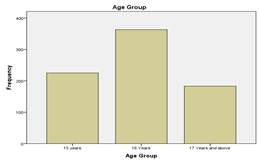
Figure 6
References
- Cutrao, J. (2009). Muslim Athletic Wear Covers Skin without Cramping Style. Journey of Faith in National Geographic Magazine, 22, 76-89.
- Dagkas, S., & Benn, T. (2006). Young Muslim women’s experiences of Islam and physical education in Greece and Britain: a comparative study. Sport Education and Society, 11(1), 21– 38.
- Di-Capua, Y. (2005). “Women, Gender, Sports and the Female Body: Arab States,†in Suad Joseph, Afsaneh Najmabadi et.al (eds.), Encyclopedia of Women in Islamic Cultures (Leiden: Brill), Vol. III. pp, 440-441. Utexas.
- Henderson, K. A., & Bialeschki, M. D. (1993). Negotiating Constraints to Women’s Physical Recreation. Loisir Et Société, 16(2), 389–411.
- Ahmad, B., Nusrat, Anees, S. K. 3. U. M., & Rafiq, R. (2017). A Study on Opinion of Girl Students of Kashmir Valleys towards Participation in Sports. ResearchGate.
- Murray, S. J. (2002). Unveiling Myths: Muslim Women and Sport, Women’s Sports Foundation, 1899 Hempstead Turnpike Suite 400 East Meadow, NY 11554.
- GANAIE, J. A. (2016). FEMALE PARTICIPATION IN SPORTS AND PHYSICAL ACTIVITIES AND THEIR RELIGIOUS VIEWS TOWARDS SPORTS IN KASHMIR VALLEY. International Research Journal of Commerce , Arts and Science,
- Shaw, S. J. (1994). Gender, Leisure, and Constraint: Towards a Framework for the Analysis of Women’s Leisure. Journal of Leisure Research, 26(1), 8–22.
- Walseth, K., & Fasting, K. (2003). Islam’s View on Physical Activity and Sport. International Review for the Sociology of Sport, 38(1), 45–60.
- Nakamura, Y. (2002). Beyond the Hijab: Female Muslims and Physical Activity. Women in Sport and Physical Activity Journal, 11(2), 21–48.
- Khan, M. Y., Jamil, A., Khan, U. A., Kareem, U., & Imran, G. (2012). Female students opinion about women's participation in sports. International Journal of Academic Research in Business and Social Sciences, 2(9), 275.
- Bilkees, B., & Kumar, S. S. (2018). Attitude of organizers, parents and players of Kashmir valley towards women sports. International Journal of Physical Education Sports Management and Yogic Sciences, 8(1), 6-10.
- Wright, P. K., & Burton, S. L. (2008). Implementation and Outcomes of a Responsibility-Based Physical Activity Program Integrated into an Intact High School Physical Education Class. Journal of Teaching in Physical Education, 27(2), 138–154.
- Marwat, M. K., Zia-Ul-Islam, S., Waseem, M., Khattak, H., & Bibi, S. (2014). Sport performance of Muslim women and different constraints in their way to participation in sport. International Journal of Humanities and Social Science, 4, 208–214.
Cite this article
-
APA : Manzoor, M., Shah, F. U. H., & Aslam, M. (2023). The Effect of Physiological and Consideration for Elite Young Females Athletes to Participate in Physical Activities. Global Sociological Review, VIII(II), 93-102. https://doi.org/10.31703/gsr.2023(VIII-II).11
-
CHICAGO : Manzoor, Mehwish, Faiz Ul Hassan Shah, and Muhammad Aslam. 2023. "The Effect of Physiological and Consideration for Elite Young Females Athletes to Participate in Physical Activities." Global Sociological Review, VIII (II): 93-102 doi: 10.31703/gsr.2023(VIII-II).11
-
HARVARD : MANZOOR, M., SHAH, F. U. H. & ASLAM, M. 2023. The Effect of Physiological and Consideration for Elite Young Females Athletes to Participate in Physical Activities. Global Sociological Review, VIII, 93-102.
-
MHRA : Manzoor, Mehwish, Faiz Ul Hassan Shah, and Muhammad Aslam. 2023. "The Effect of Physiological and Consideration for Elite Young Females Athletes to Participate in Physical Activities." Global Sociological Review, VIII: 93-102
-
MLA : Manzoor, Mehwish, Faiz Ul Hassan Shah, and Muhammad Aslam. "The Effect of Physiological and Consideration for Elite Young Females Athletes to Participate in Physical Activities." Global Sociological Review, VIII.II (2023): 93-102 Print.
-
OXFORD : Manzoor, Mehwish, Shah, Faiz Ul Hassan, and Aslam, Muhammad (2023), "The Effect of Physiological and Consideration for Elite Young Females Athletes to Participate in Physical Activities", Global Sociological Review, VIII (II), 93-102
-
TURABIAN : Manzoor, Mehwish, Faiz Ul Hassan Shah, and Muhammad Aslam. "The Effect of Physiological and Consideration for Elite Young Females Athletes to Participate in Physical Activities." Global Sociological Review VIII, no. II (2023): 93-102. https://doi.org/10.31703/gsr.2023(VIII-II).11